
Why I'm Catholic
& How the religion that was once too restrictive has brought me more freedom than ever before

I’ve been wanting to write this piece for awhile now, but have honestly struggled to put pen to paper on a topic that can seem dry for many but is so important to me. Every time I try to describe the why behind my faith, it just seems to fall short in comparison to how I feel about it. How can words suffice?
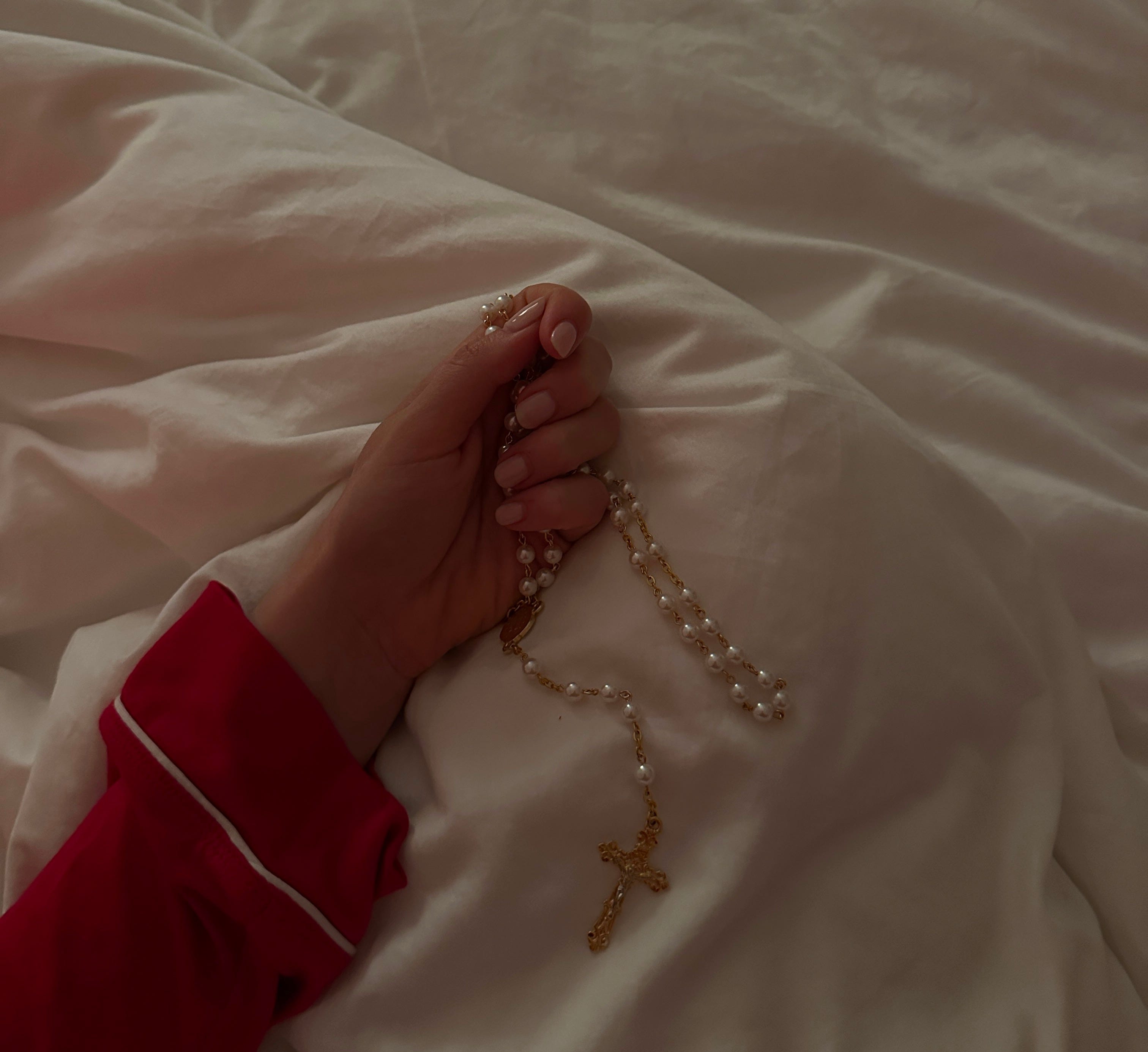
So my hope with this article is not to convert anyone — that’s God’s work and way above my pay grade. Rather, I want to explain to you my journey to devout faith as someone who, five years ago, would’ve scoffed at the idea.
I am actually a cradle Catholic — born into Catholicism, baptized in the church before the age of one, and attended mass my entire childhood. But like many cradle Catholics, I was very poorly catechized — I didn’t understand church history, didn’t care about the reverence of holy mass, and honestly found all of it a little boring and over sanitized for my taste.
In high school I explored the entire spectrum of religion: atheism when I was was a freshman, agnosticism as a sophomore, and my junior and senior years were characterized by attending a free evangelical and, later, a non-denominational church with friends. Despite my church hopping, I was confirmed Catholic per my parents request.
During college I ditched organized religion all together and was enticed by the intellectual allure of philosophic spirituality. I explored it all: new age, Christ consciousness, manifestation, Kundalini yoga, Tibetan buddhism, and more. This was appetizing for a period of time — I loved the esoteric vibe of spiritual communities. My personal life, however, was in shambles. Because I was at the center of my spiritual experience, I was at the center of my life experience as well. Ultimately, this became the downfall of new age spirituality for me — if you can save yourself, then you don’t need a savior. And that became a big problem for me when I found myself in a season of life where I desperately needed one.
My cancer diagnosis made me confront all-encompassing questions that plague most of us: what will happen when I die? Does heaven exist? If it does, would I be a good candidate for entry? Nothing like a near-death experience to set you straight.
This led me down a path of religious exploration — I was attending Catholic mass a few times per week but still with zero understanding of (or interest in) the Mass Ordinary (aka the parts of mass that remain unchanged daily), liturgical customs, eucharistic adoration, the Catechism, and more. Simultaneously I was church hopping different protestant denominations with friends and my now husband (then boyfriend). We went to Lutheran, Episcopalian, Methodist, Presbyterian, non-dom, free evangelical, and Baptist churches and enjoyed most of them but I always felt like something was missing. Honestly, I felt like I needed to go to mass afterward. I also felt perturbed by the fact that every protestant church we went to was preaching a different set of beliefs about big ticket items and all claiming their beliefs were rooted in scripture alone. I remember thinking to myself: if we’re all reading the same book, how are all of these different churches interpreting it completely differently and then saying it’s the only thing that matters?
This led me to a very difficult question: did I truly believe that The Bible was the only infallible authority for Christian faith and practice?
As I began studying church history, it was impossible to ignore that, well, no — in my opinion (and in the opinion of about 2 billion other people across the world), the bible couldn’t be the only infallible authority. We know this because The Church was formed about 300 years before The Bible was written and canonized. So for 300 years, The Church gathered and practiced Christianity through spoken word, written word, and tradition. No bible in sight. In fact, the large majority (over 85%) of early Christians were illiterate — so we know that early Christianity was not textually-oriented at all.
This is an uncomfortable truth for many because it points to the fact that we cannot divorce faith from history — and my exploration of church history is ultimately what led me back to my Catholic faith.
Today, I find deep interest in both the studying of Catholicism and the practicing of it — what once felt stale and boring is now endlessly fascinating to me. Don’t get me wrong — no one is mistaking mass for a Harry Styles concert. In fact, it is rarely entertaining (in the worldly sense) and that’s by design. I shared on Instagram earlier this week that I heard a story of a newer Catholic telling his friend that he was having a hard time connecting with his priest and wasn’t getting a lot out of mass. His friend turned to him and said, “That’s okay, it’s not about you.”
Mass is designed for one thing: deep reverence for Jesus’s sacrifice for us. It’s also practiced everyday of the week and the scriptural readings are the same at every church across the globe on any given day. This is important to me because it addresses the continuity issues I found in different protestant denominations. Rome is authoritative in every sense of the word — Catholic doctrine is clear; denoted by man and guided by the holy spirit for over 2000 years. The Catechism (and The Bible, of course) offer a framework for living a devout and fulfilling life, and it is up to us whether or not we follow it.
The last thing I’ll say is that I know there is a lot of Catholic slander thrown around: Mary worship, praying to saints, purgatory, and more. A massive part of becoming a devout Catholic is wrestling with all of these things and truly doing your due diligence to find accurate answers. This journey is captivating for the curious and suffocating for the indifferent but I can guarantee you that there are comprehensive answers to all of the questions you have.
If you’re Catholic-curious, I cannot recommend the work of Trent Horn enough (his book Why We’re Catholic is a don’t miss) alongside Pints with Aquinas Podcast (linking this very eye-opening episode with a former protestant pastor) and the Ignatius Study Bible. My DMs are also always open — I love to chat this stuff through with an open mind.
xx
Anna
I started following you two years ago and when you would talk about your faith it called into question my own. Once I got engaged I knew I needed to deepen my relationship with God and although im Jewish I never felt a calling to Judaism. I was raised secular but my closest friends were catholic and I felt a deep pull to the church. I gave judaism a good faith effort by enrolling in classes at the synagogue but didn’t feel any connection. Fast forward to today I’m in OCIA and my husband and I attend mass every Sunday, my husband is catholic and the priest is very happy I brought him back to the church lol. All in all we are loving mass, we pray together and read the bible it’s such an intimate experience and Im so grateful for this journey!
Amazing piece, Anna. As a cradle catholic myself, I relate a lot about what you wrote.